Side-by-Side Comparison
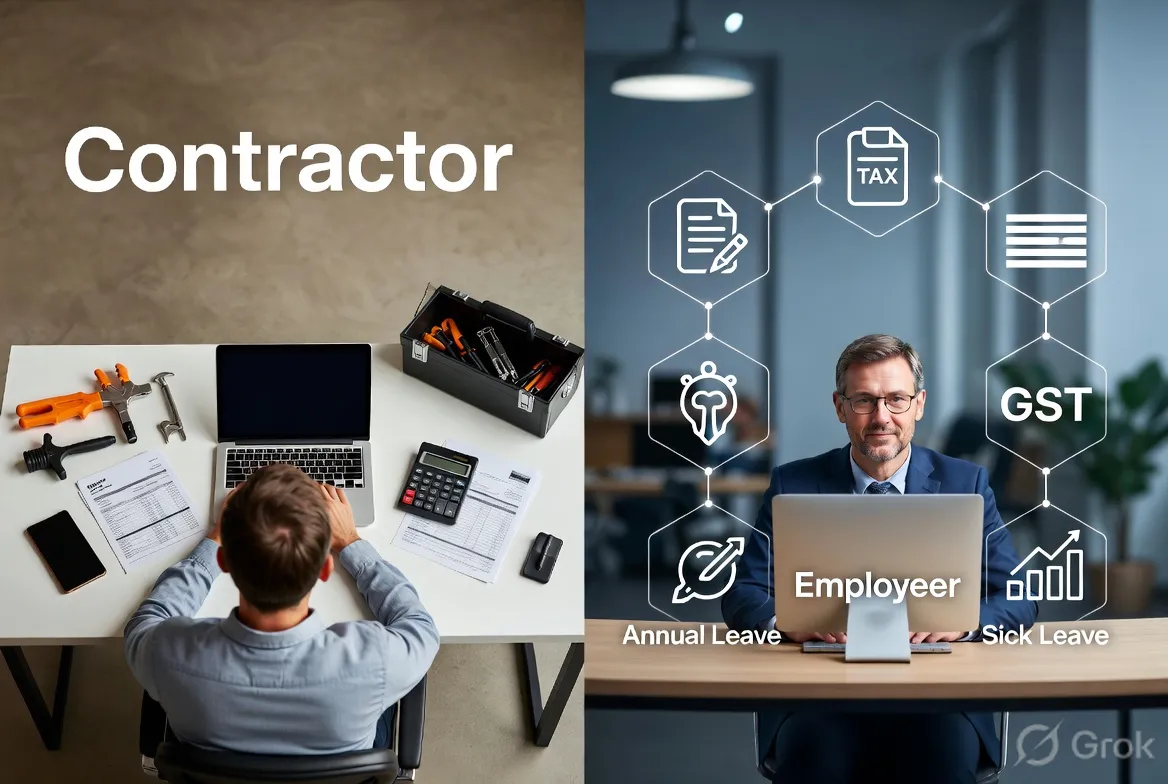
| Feature | Employee | Contractor |
|---|---|---|
| Tax withheld | PAYG withheld by employer | Self-managed — pay quarterly instalments or at tax time |
| Superannuation | 12% paid by employer (2025-26) | Usually self-funded — employer may be obligated in some cases |
| GST | Not applicable | Must register if turnover > $75,000/year |
| Annual leave | 4 weeks paid leave per year (minimum) | No paid leave — you only earn when you work |
| Sick leave | 10 days personal/carer's leave per year | No paid sick leave |
| Long service leave | Accrues after 7–10 years with same employer | Generally not applicable (varies by state/industry) |
| Workers compensation | Covered by employer's policy | Must hold own income protection or public liability insurance |
| Tax deductions | Limited to unreimbursed work-related expenses | All genuine business expenses deductible |
| Income security | Unfair dismissal protections apply | Contract terms govern — no unfair dismissal protection |
| ABN required | No | Yes — to invoice clients and avoid 47% withholding |
Am I an Employee or Contractor?
The label on your contract does not determine your status — the ATO and Fair Work look at the totality of the working relationship. Key factors:
If you are working out the downstream tax effect of that classification, the Australian income tax guide is the best place to compare how wages, deductions, and tax rates fit together.
You set your own hours
You work for multiple clients
You quote for a specific result
You bear financial risk (e.g., fix defective work at your cost)
You supply your own tools and equipment
You can subcontract or delegate the work
The employer sets your hours
You work exclusively or mainly for one business
The work is ongoing and integral to the business
The employer provides equipment and training
You are paid by time (hourly/weekly), not by result
There is a policy of no subcontracting
No single factor is decisive. The ATO weighs all factors together. Use the ATO's Employee/Contractor Decision Tool at ato.gov.au for a definitive assessment.
Tax Obligations as a Contractor
Income Tax — Self-Assessment
No tax is withheld from contractor invoices (unless you enter voluntary withholding arrangements). You lodge an annual tax return and pay tax on your net profit (revenue minus deductible expenses). If you expect to owe more than $500 at tax time, the ATO will ask you to pay PAYG instalments quarterly, based on last year's income or a notional tax amount.
Record-keeping usually matters more for contractors than employees, so the tax return checklist is a useful companion once you start invoicing and claiming expenses.
GST — Quarterly BAS
If registered for GST, you lodge a Business Activity Statement (BAS) quarterly (or monthly/annually by choice). You remit GST collected from clients minus GST credits you paid on business purchases. The net amount is due to the ATO within 28 days after each quarter end.
Superannuation — Your Responsibility
Unless a client is legally required to pay your super (see FAQ below), you need to fund it yourself. A practical starting point is to set aside at least 12% of gross income so you are not falling behind an employee on the same earnings. If your cash flow allows it, concessional contributions can also be tax-effective.
If you want the cap rules, Division 293 thresholds, or bring-forward rules in one place, read the superannuation contributions guide.
Converting Contractor Rate to Equivalent Salary
This is where people often underquote. A contractor day rate is not the same thing as an employee salary, because the contractor has to fund costs that an employee receives indirectly. In practice, you usually need to cover:
As a starting point, many contractors multiply the salary they want to replicate by 1.35 to 1.40. On that basis, matching a $120,000 employee package usually means generating about $162,000 to $168,000 in contractor revenue before expenses.
Before accepting a rate, run it through the contractor calculator so you can compare the headline day rate with the after-tax reality.
Common Contractor Structures
Sole Trader
Pros
- • Simplest setup
- • No ASIC fees
- • Losses can offset other income
Cons
- • Full personal liability
- • No income splitting
- • Higher tax at top incomes
Best for: Starting out / lower income
Company (Pty Ltd)
Pros
- • Limited liability
- • 30% (or 25%) corporate tax rate
- • Credibility with large clients
Cons
- • ASIC fees and admin
- • No 50% CGT discount on company gains
- • Retained profits taxed at personal rate on distribution
Best for: Established, higher-income contractors
Trust
Pros
- • Income splitting across family members
- • Asset protection
- • Flexibility
Cons
- • Complex and expensive to set up
- • Must distribute all income annually
- • ATO scrutiny of trust distributions
Best for: Family businesses with multiple beneficiaries
Frequently Asked Questions
Do I have to pay super as a contractor?
It depends. If you are engaged primarily for your labour (rather than a result) and you work under a contract wholly or principally for your personal labour and skills, the engaging business must pay super contributions on your behalf — even if you invoice through an ABN. If you are a genuine business contractor providing a result-oriented service through a company or trust, you generally manage your own super.
What daily rate is equivalent to a $100,000 employee salary?
As a sense-check, start with annual salary divided by about 220 working days, then add a loading for super, leave, insurance, admin, and downtime between contracts. On a $100,000 salary, that usually lands around $545–$636 a day, but the right figure depends on how steady the work is and which costs you are carrying yourself.
Do contractors pay GST?
You must register for GST if your annual turnover exceeds $75,000. Once registered, you add 10% GST to your invoices and remit the GST collected to the ATO (less any input tax credits). Many contractors register voluntarily even below the threshold to appear professional and to claim input tax credits.
What is sham contracting?
Sham contracting is when an employer disguises an employment relationship as an independent contracting arrangement to avoid paying entitlements like super, leave, and workers compensation. It is illegal under the Fair Work Act. The ATO and Fair Work Ombudsman both actively investigate sham arrangements.
Can I claim more tax deductions as a contractor?
Yes. Contractors can claim all genuine business expenses: home office costs, professional subscriptions, tools and equipment, work-related travel, business insurance, and accounting fees. Employees can only claim work-related expenses not reimbursed by their employer, which is usually a narrower scope.
Do I need an ABN to contract?
You need an ABN to invoice for goods or services in Australia. Without one, clients are required to withhold 47% tax from your payments (top marginal rate + Medicare levy). Registering an ABN is free through the ABR website.